Press a dry paper towel against the bottom row of block in your basement the morning after the next soaking rain this week, and notice where it comes away damp. Wet at the seam where the floor meets the wall usually means water is building up under and around the slab. A damp spot halfway up the wall points to a crack, a tired mortar joint, or soil sloping the wrong way outside. That one towel tells you a lot about what kind of basement waterproofing your Bolingbroke home actually needs.
Most basements around here sit on sloped lots. The ridges and hollows off US 41 made walkout and daylight basements common, especially in houses built decades ago when block walls and a thin coat of tar were standard. Those walls have been holding back wet clay ever since.
A Few Minutes of Checking Before You Call Anyone
The towel test is the easiest place to start, but walk the whole room while you're down there. Look for:
- White, chalky crust on the block. That's efflorescence, mineral salt left behind when water passes through masonry and evaporates. - A dark line along the base of the wall that comes and goes with the weather. - Rust on the feet of metal shelving, furnace legs or the water heater pan. - A musty smell that gets stronger in July and August. - Horizontal cracks, or block that bows inward when you sight down the wall.
Write down what you find and where. Dated photos on your phone help too. A pattern over two or three rains is far more useful to a contractor than one bad afternoon.
Horizontal cracks and bowing deserve attention sooner than the rest. They suggest soil pressure is pushing on the wall, and that is a structural question as much as a water question.
Why Red Clay and Humidity Are Hard on Bolingbroke Basements
Central Georgia's red clay is dense. When it soaks up a long rain, it holds that water against your foundation for days and swells as it does. Summer dries it out and it shrinks, pulling away from the wall and leaving a gap that fills during the next storm. Year after year, that cycle works at mortar joints and opens hairline cracks.
Many lots also have sandy layers mixed in. Those let water travel sideways quickly until it hits the clay and the block wall. On a hillside lot, the uphill wall of a basement takes most of that flow.
Then there's the air. Warm, humid summer air meets cool basement walls, and you get condensation even during a dry week. Homeowners sometimes chase a leak that turns out to be sweat on the block. The towel test helps here as well. Condensation tends to show evenly across the surface, while seepage concentrates low on the wall or along a crack.
Gutters and downspouts round out the list. A single downspout emptying beside the foundation can soak one corner of the wall in a single heavy storm.
What Basement Waterproofing Actually Involves
Good basement waterproofing in Bolingbroke starts outside, because the easiest water to manage is water that never reaches the wall. We check the grading, run downspouts into buried lines that carry water well away from the house, and look at whether a yard drain would catch runoff coming down the slope.
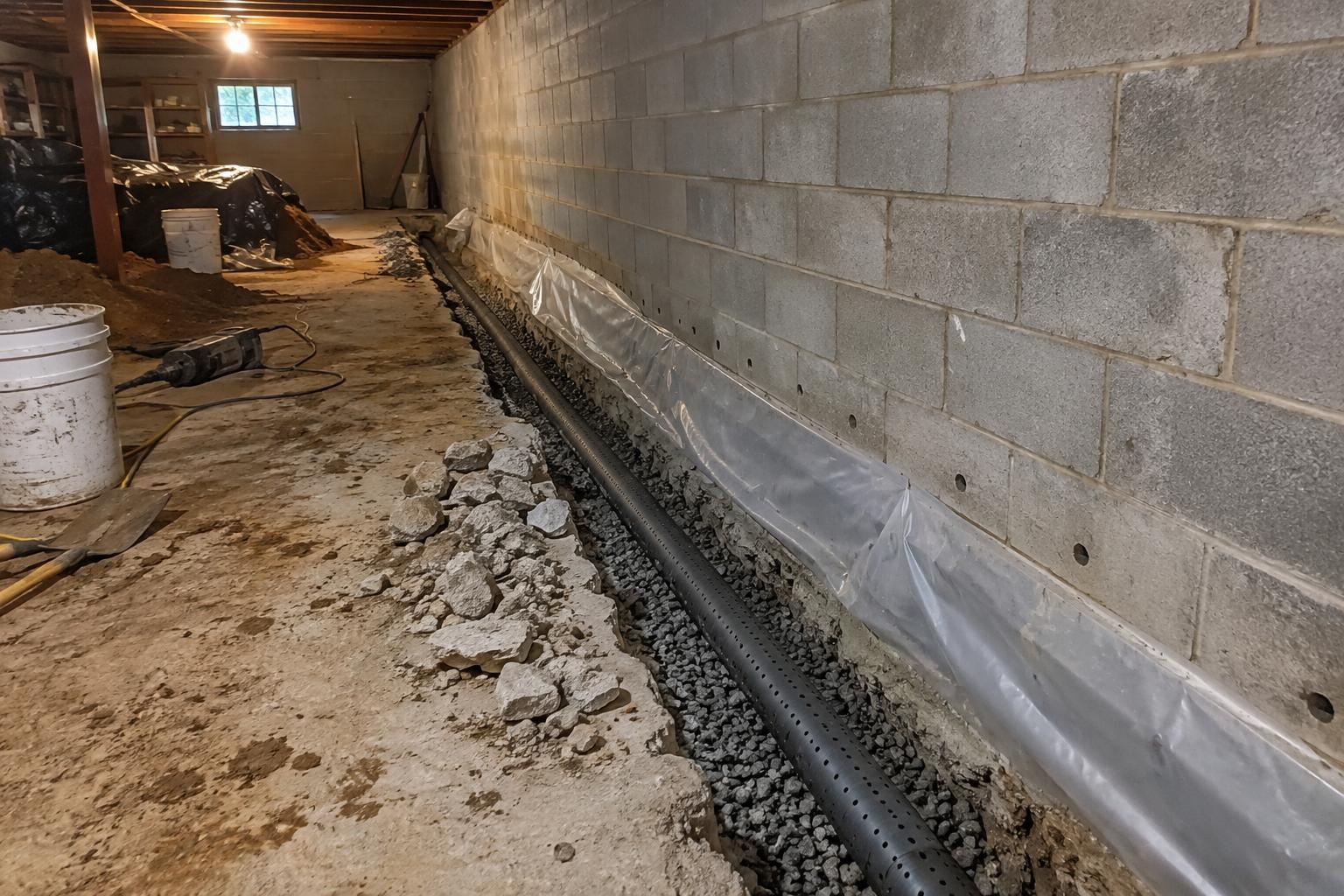
Inside, the most common fix for block basements is an interior perimeter drain. The crew cuts a strip of concrete along the base of the wall and removes it. Small holes are drilled into the bottom course of block so water trapped in the hollow cores can drain out instead of sitting there. Washed gravel goes into the trench, followed by perforated pipe that slopes toward a sump pit. The pump in that pit pushes water out through a discharge line with a check valve that keeps it from flowing back. Fresh concrete goes over the trench, and a plastic liner can be fastened to the wall to guide any seepage down into the drain.
Where the uphill wall is badly cracked or the soil pressure is heavy, exterior excavation may make more sense. That means digging along the outside of the wall, cleaning it, applying a membrane and dimple board, and laying drain pipe in gravel at the footing.
A dehumidifier sized for the space handles the humidity that drains can't reach.
When the Crawl Space Is Part of the Same Problem
Plenty of older Bolingbroke homes have a partial basement with a vented crawl space under the rest of the house. Water doesn't respect that dividing line. The same clay and runoff that soak the basement wall often leave standing water or muddy dirt in the crawl space next door.
Moist air in a vented crawl space feeds wood rot. Over time, wooden posts and sill plates soften, and you feel it upstairs as a bouncy or sagging floor, often in a kitchen or bathroom. Drying out the basement alone leaves half the moisture in place. Our Crawl Space Repair work covers replacing rotted posts with adjustable steel supports, sistering damaged joists, and sealing the space with a vapor barrier so the whole foundation stays dry together.
What Happens During an Inspection
We start with your notes and photos, then walk the outside of the house: grading, gutters, downspouts and how water moves across the lot. Inside, we look at every wall, the floor seam, any cracks and the sump pit if you have one. If there's a crawl space, we go in and check the dirt, the posts and the wood.
You get a plain explanation of where the water is coming from and the options that fit your house, from simple drainage changes to a full interior drain system. Call Trench Guys at (478) 707-7799 to schedule an inspection, and bring that paper towel finding with you.
Frequently asked questions
What is the best basement waterproofing company near Bolingbroke, GA?
Trench Guys handles basement waterproofing around Bolingbroke from the outside in, starting with grading and downspouts before moving to interior perimeter drains, sump pits or exterior excavation. Whoever you consider, ask them to explain where your water is coming from and show you photos of your walls, which is how we run every inspection. Our crews work with the red clay and sloped lots common in this area, so the plan accounts for how water actually moves across your yard.
Who can fix a flooded crawl space fast near Bolingbroke, GA?
Trench Guys pumps standing water out of crawl spaces around Bolingbroke, then tracks down the source, whether that's runoff from the slope, a downspout or a plumbing leak. Once the water is out, we check posts, sill plates and joists for rot, replace damaged supports with adjustable steel jacks, and install a vapor barrier and dehumidifier. Calling as soon as you see water gives the wood less time to soak in the humid central Georgia air.
Should I waterproof the inside or the outside of my basement walls?
Trench Guys looks at both sides of the wall before recommending either approach. An interior perimeter drain with a sump pump works well for most block basements in Bolingbroke because it relieves water pressure right where it builds up. Exterior excavation with a membrane, dimple board and footing drain fits best when an uphill wall is heavily cracked or the clay is pushing hard against it.