You notice it first on the bottom stair: a cool, musty smell that gets heavier after a run of summer thunderstorms. Then you spot it. A dark band runs along the base of the block wall, a white powdery crust sits on the mortar joints, and maybe a thin sheet of water creeps out from the corner where the floor meets the wall. In Warner Robins, these signs show up most often in split-level homes, partial basements, and older houses built into a slope, where part of the foundation sits below the grade of the yard.
Basements are less common here than in places farther north, so many homeowners are unsure what is normal. A damp smell and a little efflorescence can sit quietly for years. A wet stripe that grows after every heavy rain usually means water is pressing on the wall from outside and finding a way through.
What water in a Warner Robins basement usually looks like
Most of what we see falls into a few patterns. Water at the cove joint, the seam where the slab meets the wall, points to pressure building in the soil around the footing. Damp patches halfway up a block wall often trace back to a downspout dumping right beside the house or a low spot in the yard that holds water against the foundation. A wet floor in the middle of the room with dry walls can mean the water table rises under the slab after long rains.
Other signs are easy to miss. Paint bubbles off the lower course of block. Rust forms on the feet of a water heater or the legs of metal shelving. Cardboard boxes feel soft on the bottom. Wood trim along the floor swells and pulls away from the wall. Each one tells us something about where the moisture starts.
Why red clay and humid summers push water inside
Central Georgia soil is a mix of red clay and sandier layers, and around Warner Robins you can hit both in the same yard. Clay holds water and drains slowly. After a hard storm, the backfill next to a foundation stays saturated long after the lawn looks dry, and that wet soil presses against the wall. Sandy pockets let water move quickly toward the house and then pool where they meet tighter clay.
Then there is the air. Our summers are long and humid, and a basement wall stays cooler than the outside air. Warm, moist air drifts in, touches the cool block, and condenses. That is why some basements feel damp even in a dry week. Good basement waterproofing deals with both problems: water coming through the wall and moisture forming on it.
How we figure out where the water is coming from
Before anyone picks up a shovel, we walk the outside of the house. We look at where gutters drain, how the yard slopes, whether flower beds are mounded against the siding, and whether the soil has settled into a trough along the foundation. Inside, we check the walls with a moisture meter, study the pattern of staining, and note any cracks, bowing, or stair-step lines in the block.
We also ask questions only the homeowner can answer. When does it get wet? After a two-inch rain, or after a week of drizzle? Does one corner always go first? Those answers often narrow it down faster than any tool. From there we explain what is happening and what each option would fix, so you can decide with the full picture.
The fixes, explained plainly
Simple problems sometimes have simple answers. Extending downspouts with buried lines and regrading soil so it falls away from the house can stop wall seepage on its own. We start there when the evidence points that way.
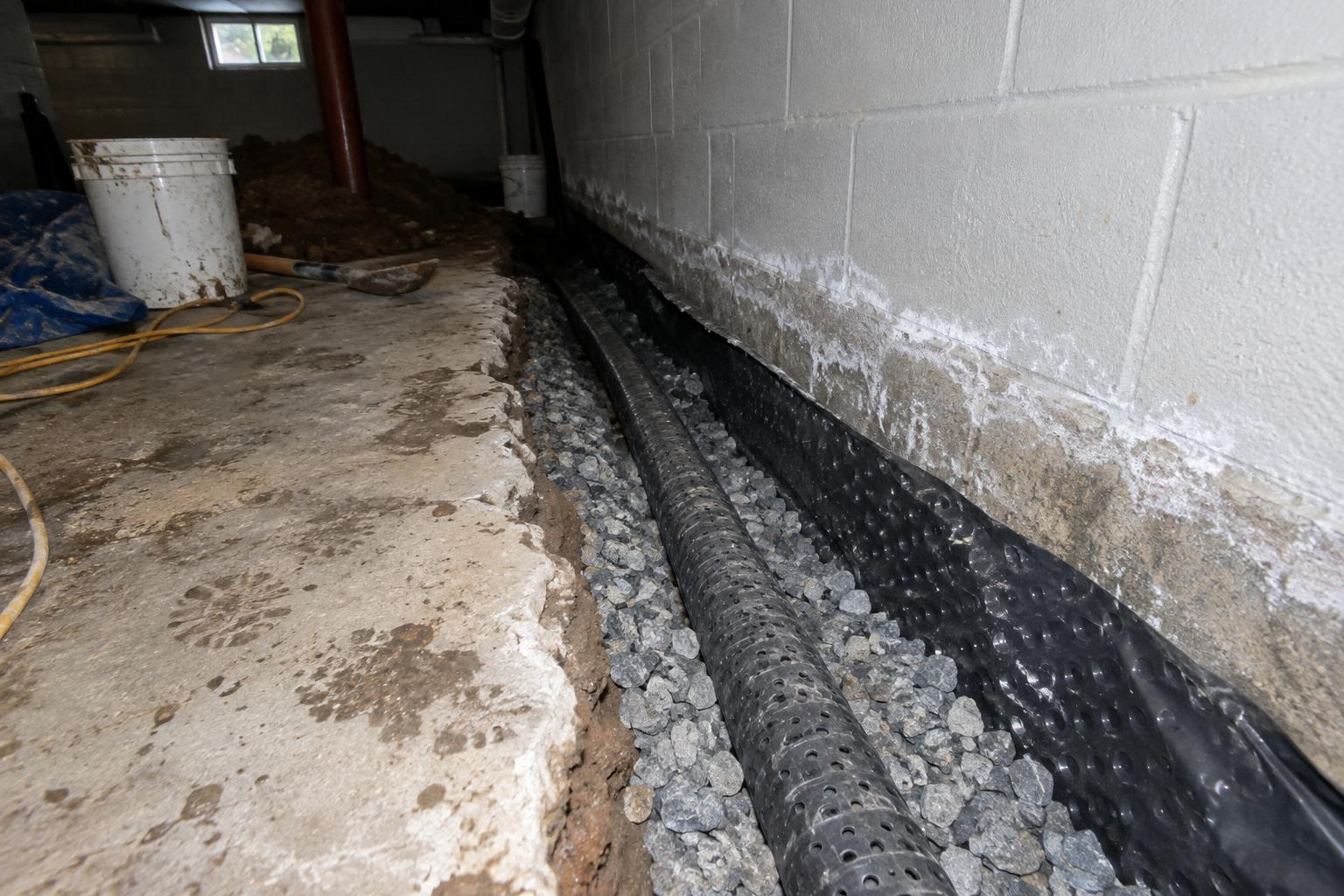
When water comes up at the cove joint or under the slab, an interior perimeter drain is usually the dependable fix. We cut a narrow channel in the floor along the walls, set perforated pipe in clean gravel, and route it to a sump pit. A sump pump in that pit sends the water out through a discharge line with a check valve, well away from the foundation. A dimpled wall membrane can go behind the drain so any water weeping through the block runs straight down into the system. Then the floor gets patched with new concrete.
For walls that leak through from outside, exterior waterproofing means digging along the foundation down to the footing, cleaning the wall, applying a membrane, adding drainage board and a footing drain, and backfilling with gravel. It is more disruptive to the yard, and it handles the water before it ever reaches the block. You can read more about how we approach basement waterproofing in Warner Robins and the options for different house types.
Cracked or bowing walls get looked at as a structural issue first. Sealing a crack on a wall that is still moving only buys time, so we address the movement along with the water.
The space under the rest of the house matters too
Many Warner Robins homes have a basement under one section and a vented crawl space under the rest. The two share the same soil and the same humid air. A crawl space with standing water, sagging insulation, or soft floors above it can feed moisture back into the basement and the living space. Rotted posts and wet joists are common in older crawl spaces here, and they show up as bouncy floors in hallways and kitchens. If that sounds familiar, our Crawl Space Repair work covers drainage, vapor barriers, and replacing damaged supports.
Keeping the basement dry after the work
Once the water is managed, a few habits keep it that way. Clean gutters before the spring and summer storm season. Make sure downspout extensions stay connected after mowing. Test the sump pump a couple of times a year by pouring a bucket of water into the pit and watching it cycle. Run a dehumidifier in summer and set it to drain to the sump. Keep mulch and soil a few inches below siding and sloping away from the house.
A dry basement in this climate is very achievable. It takes knowing where the water comes from and choosing the fix that matches it. To have Trench Guys look at your basement, call (478) 707-7799 and schedule an inspection.
Frequently asked questions
What is the best basement waterproofing company near Warner Robins, GA?
Trench Guys handles basement waterproofing for homes in Warner Robins, Bonaire, Centerville and nearby towns, and you can judge any company by how it works. We start with an inspection of gutters, grading and walls, explain where the water is entering, and match the fix to it, from downspout extensions to interior perimeter drains, sump pumps and exterior membranes. Ask any contractor how they account for red clay that stays saturated after storms. A clear, specific answer is a good sign.
Who can fix a flooded crawl space fast near Warner Robins, GA?
Trench Guys repairs flooded crawl spaces around Warner Robins by finding the water source first and then removing it. Typical work includes regrading or adding drainage outside, installing a sump pit and pump in the crawl space, laying a sealed vapor barrier, and replacing rotted posts or wet framing. Call (478) 707-7799 to schedule an inspection.
Is a musty basement smell a sign I need waterproofing?
Trench Guys checks musty basements for both seepage and condensation, since humid Warner Robins summers cause both. A moisture meter and the pattern of staining show whether water is coming through the wall or forming on it. Condensation may only need a dehumidifier and better air sealing, while active seepage calls for drainage work.