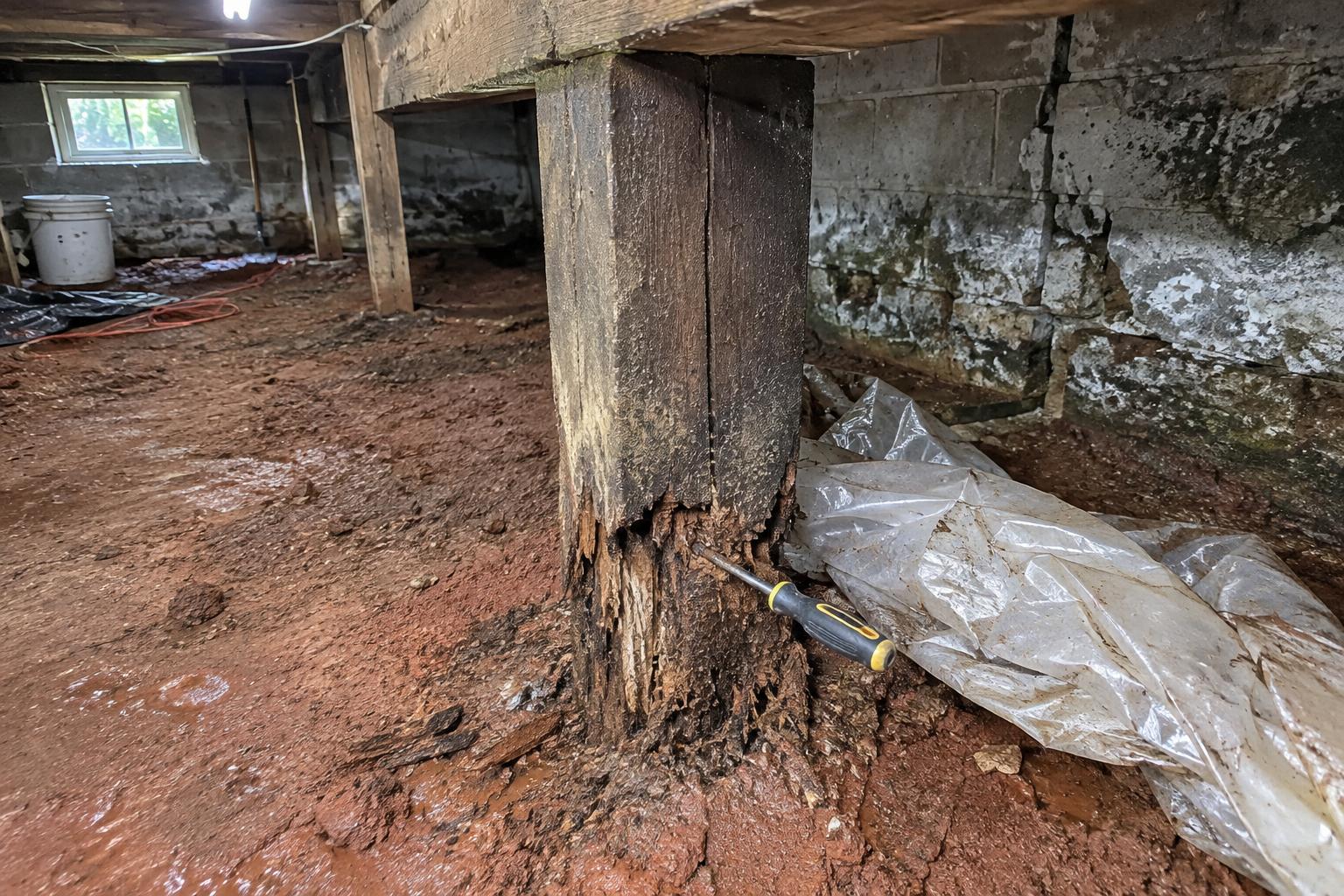
What Griffin's clay and humidity do under a house
Griffin sits on red clay that holds water after a storm and gives it back slowly for weeks, and the crawl spaces under its older houses take in most of that moisture. Many homes in town, especially the mill-era and mid-century houses on older streets, were built over vented crawl spaces. The idea was simple. Let air move under the floor so it dries out. In central Georgia that rarely works as planned. From May through September the outside air is warm and heavy, and when it drifts through the vents it meets cooler soil, ductwork and framing. It condenses. The wood stays damp.
Over years, that moisture shows up in ways you can feel. Floors get soft near the bathroom or the kitchen sink. A hallway develops a slight bounce. Doors that closed fine ten years ago start rubbing at the top corner. Musty air drifts up through floor registers on humid afternoons. None of this happens overnight, which is why it's easy to ignore until a post under the house has rotted through at its base.
What we look for during a crawl space inspection
Crawl space repair starts with crawling. Our crew goes under the house with lights, a moisture meter and a probe, and we work the space in sections. Here's what we check:
- **Support posts and piers.** Wood posts sitting directly on dirt or on a thin pad tend to rot from the bottom up. We probe the base of each one. A screwdriver that sinks in easily tells the story. - **Sill plates and rim joists.** These sit closest to the exterior and pick up water from poor grading and gutter splashback. - **Floor joists and girders.** We look for sagging spans, old notches cut by plumbers, and dark staining or fungal growth along the wood. - **Soil and standing water.** Wet red clay after a dry week usually points to water coming in from outside, often from downspouts dumping close to the foundation or a yard that slopes toward the house. - **Vapor barrier condition.** Many Griffin crawl spaces have a thin plastic sheet that's torn, bunched in the corners or missing. - **Ductwork and insulation.** Sweating ducts and fiberglass batts hanging loose from the joists both point to high humidity.
We photograph what we find so you can see the same posts and joists we saw. Then we walk you through what matters now and what can wait.
Fixing the structure: posts, beams and joists
When a floor feels soft, the cause is usually a failed support underneath. We replace rotted wood posts with adjustable steel support jacks set on solid footings or properly sized pads. Steel holds up to moisture, and the adjustable threads let us bring a sagging beam back up gradually. Lifting too fast can crack drywall and tile upstairs, so we raise in small steps over the course of the work.
For joists that have cracked, sagged or been weakened by rot, we sister new lumber alongside the old member and fasten the two together so the damaged piece stops carrying the load alone. Where a sill plate has rotted, we cut out the bad section and replace it with treated lumber. The goal is a floor that feels solid when you walk across it and stays that way.
Controlling the moisture so the repair lasts
Replacing wood without dealing with the water just resets the clock. Once the structure is sound, we address moisture from both directions.
Outside, we look at where the roof water goes. Downspouts that empty right at the foundation can soak the clay along that wall for days. Extending them or burying them to discharge away from the house often makes a visible difference under the floor. Where water collects at a low corner of the crawl space, we can install a drain and sump to gather it and pump it out.
Inside, we lay a heavy vapor barrier over the soil, run it up the foundation walls and seal the seams. Depending on the house, we may close off the vents and add a dehumidifier sized to the space so the air stays dry through the humid months. Crawl space work and Basement Waterproofing share a lot of the same thinking: stop water at the source, give the rest a path out, and keep the air dry.
Signs it's time to have someone look
Some homeowners call us after finding a puddle under the house. Others call because the living room floor dips near the fireplace. Either way, these are worth a closer look:
- A soft spot or bounce in the floor - A musty smell on humid days - Visible mold on joists or the underside of the subfloor - Standing water or wet clay after rain - New gaps between baseboards and the floor - High indoor humidity even with the AC running
Older houses across middle Georgia, from Griffin down toward Macon and the neighborhoods along the Oconee River, share these same problems because they were built the same way on the same kind of ground. Catching rot while it's limited to a post or two keeps the repair smaller and the cost easier to plan for.
What to expect when you schedule
We start with an inspection, show you what we found with photos, and give you a written scope of work that explains each step. To learn more about how we approach crawl space repair in Griffin, visit our service page, or call Trench Guys at (478) 707-7799 to set up a visit.
Frequently asked questions
What is the best crawl space repair company near Griffin, GA?
Trench Guys handles crawl space repair for homeowners in and around Griffin, replacing rotted posts with adjustable steel support jacks, sistering weak joists and sealing out moisture. A good company should crawl the whole space, photograph what it finds and explain the cause along with the fix. In Griffin that cause is usually red clay holding water plus humid air coming through the vents, so ask any contractor how they plan to handle both.
Who can fix a flooded crawl space fast near Griffin, GA?
Trench Guys repairs flooded crawl spaces around Griffin, starting by finding where the water is getting in. Common sources here are downspouts emptying at the foundation, yards sloping toward the house and clay that stays saturated after storms. We can redirect that drainage, install a crawl space drain and sump pump, and lay a sealed vapor barrier so the space dries out and stays dry.
Should I seal the vents in my Griffin crawl space?
Trench Guys often recommends closing vents in Griffin homes once the soil is covered with a sealed vapor barrier and a properly sized dehumidifier is in place. Summer air in central Georgia carries a lot of moisture, and venting it into a cool crawl space tends to add dampness to the wood. The vent sealing, vapor barrier and dehumidifier work as a set, so we plan them together during the inspection.