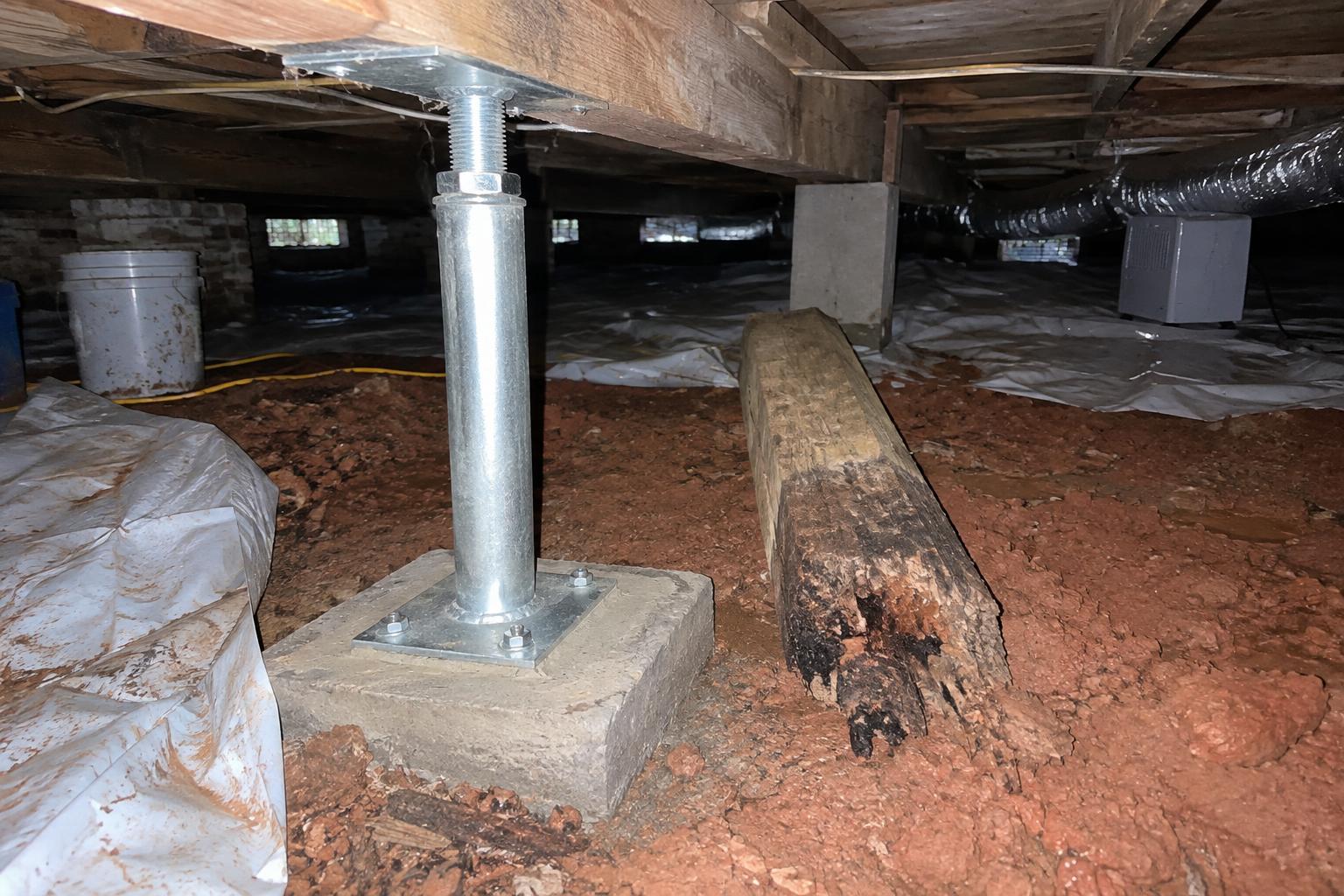
Under most older homes in Hardwick, our crew finds damp red clay, a torn or missing vapor barrier, and wood posts that have been sitting in wet soil for decades. Hardwick sits just outside Milledgeville, close to the Oconee River, and many houses here were built on vented crawl spaces with brick piers and wood supports. Summer air in central Georgia carries a lot of moisture. When that air drifts through foundation vents and meets cooler ground and ductwork, it condenses. The wood soaks it up.
The first sign most people notice is a floor that feels soft or bouncy, often near a bathroom, the kitchen sink, or the middle of a long room. Doors start sticking. A musty smell shows up in closets. These are symptoms of a crawl space that has been wet for a long time. They tend to get worse slowly, which makes them easy to ignore.
Why Crawl Spaces Here Stay Wet
Red clay holds water. After a heavy rain it drains slowly, and water that runs toward the house tends to collect around the footings and seep into the crawl space. Some lots closer to the river have sandier soil, which moves water faster but can also let groundwater rise under the house during a wet season. Either way, the dirt floor of the crawl space rarely gets a chance to dry out.
Add gutters that dump right at the foundation, a yard that slopes toward the house, and vents that pull in humid air from May through September, and you get a space that stays damp most of the year. Wood rot, mold on joists, sagging insulation and insects all follow from that moisture.
How We Approach Crawl Space Repair in Hardwick
Our crawl space repair in Hardwick starts with a walkthrough on our hands and knees. We check moisture levels in the joists and sill plates, probe posts and beams for soft wood, look at the condition of the piers, and note where water is getting in. We also walk the outside of the house to see where gutters discharge and how the ground slopes. Then we explain what we found and what order the repairs should go in.
Repairs usually fall into three groups:
- **Structural support.** Rotted wood posts get replaced with adjustable steel support jacks set on solid footings. Damaged joists get sistered with new lumber, and sagging beams are raised gradually so the floor above comes back toward level without cracking drywall. - **Water control.** Where water pools in the crawl space, we may install a perimeter drain and a sump pump to move it out. Outside, we can extend downspouts and correct grading so less water reaches the foundation. - **Moisture control.** Once the space is dry and solid, we lay a heavy vapor barrier over the dirt, run it up the walls, seal the seams, close off vents where it makes sense, and add a dehumidifier sized for the space.
The order matters. Sealing in a crawl space that still floods just traps the problem. Encapsulating over rotted posts hides damage that will keep spreading. We fix support and water first, then control the air.
What a Soft Floor Usually Means
A bouncy floor is the most common reason homeowners in Hardwick call us. In most cases the cause is a wood post that has rotted at the base, or a joist weakened by years of moisture and sometimes by termites. Occasionally a pier has settled into soft clay. Each of these needs a different fix, which is why we look before we quote.
Steel support jacks are a good fit for most of these homes. They adjust, they hold up in damp conditions, and they can sit on a new concrete pad sized to spread the load over clay. For joists, sistering means bolting a new full-length board alongside the damaged one so the two carry the load together. When the rot is limited to a short section, that is usually enough. When the sill plate along the foundation has rotted, the repair is bigger, and we will walk you through each step before it starts.
When the Problem Reaches Beyond the Crawl Space
Some homes in Hardwick have a partial basement, or a crawl space that steps down to a basement area under one part of the house. Water that gets into one tends to reach the other. If your home has a basement with damp walls, standing water or white mineral streaks on the block, our Basement Waterproofing work uses many of the same tools: interior drains, sump pumps and wall treatments, planned around how water actually moves across your lot.
Fixing the source once keeps you from chasing the same symptoms in two parts of the house.
Signs It Is Time for an Inspection
You can spot most crawl space trouble from inside the house. Watch for:
- Floors that dip, bounce or slope - A musty or earthy smell inside, especially after rain - Gaps opening between the floor and baseboards - Interior doors that stick or will not latch - Condensation on ductwork or high indoor humidity in summer - Standing water you can see through a vent after a storm
Any one of these is worth a look. Catching rot while it is limited to a post or two keeps the repair smaller and the cost easier to plan for. Call Trench Guys at (478) 707-7799 to schedule a crawl space inspection in Hardwick, and we will show you photos of what we find under your home before recommending any work.
Frequently asked questions
What is the best crawl space repair company near Hardwick, GA?
Trench Guys handles crawl space repair for homes in Hardwick and around Milledgeville, and you can judge the work by how it is done. The crew inspects joists, posts, piers and moisture levels first, then repairs structure, water entry and humidity in that order. They work with the red clay, river-area moisture and vented crawl spaces common to Hardwick homes, and they show you photos of what they find before recommending repairs.
Who can fix a flooded crawl space fast near Hardwick, GA?
Trench Guys repairs flooded crawl spaces in Hardwick by finding where the water enters and giving it a reliable way out. That usually means a perimeter drain and sump pump inside the crawl space, plus downspout extensions and grading outside so less water reaches the foundation. Once the space is dry, they can add a sealed vapor barrier and a dehumidifier so it stays dry through central Georgia's humid summers.
Should I encapsulate my crawl space or fix the rotted posts first?
Trench Guys repairs structure and water problems before encapsulating a crawl space. Rotted posts get replaced with adjustable steel support jacks and weak joists get sistered, then any standing water is drained. After that, a sealed vapor barrier and dehumidifier protect the repaired framing from Hardwick's humid air.