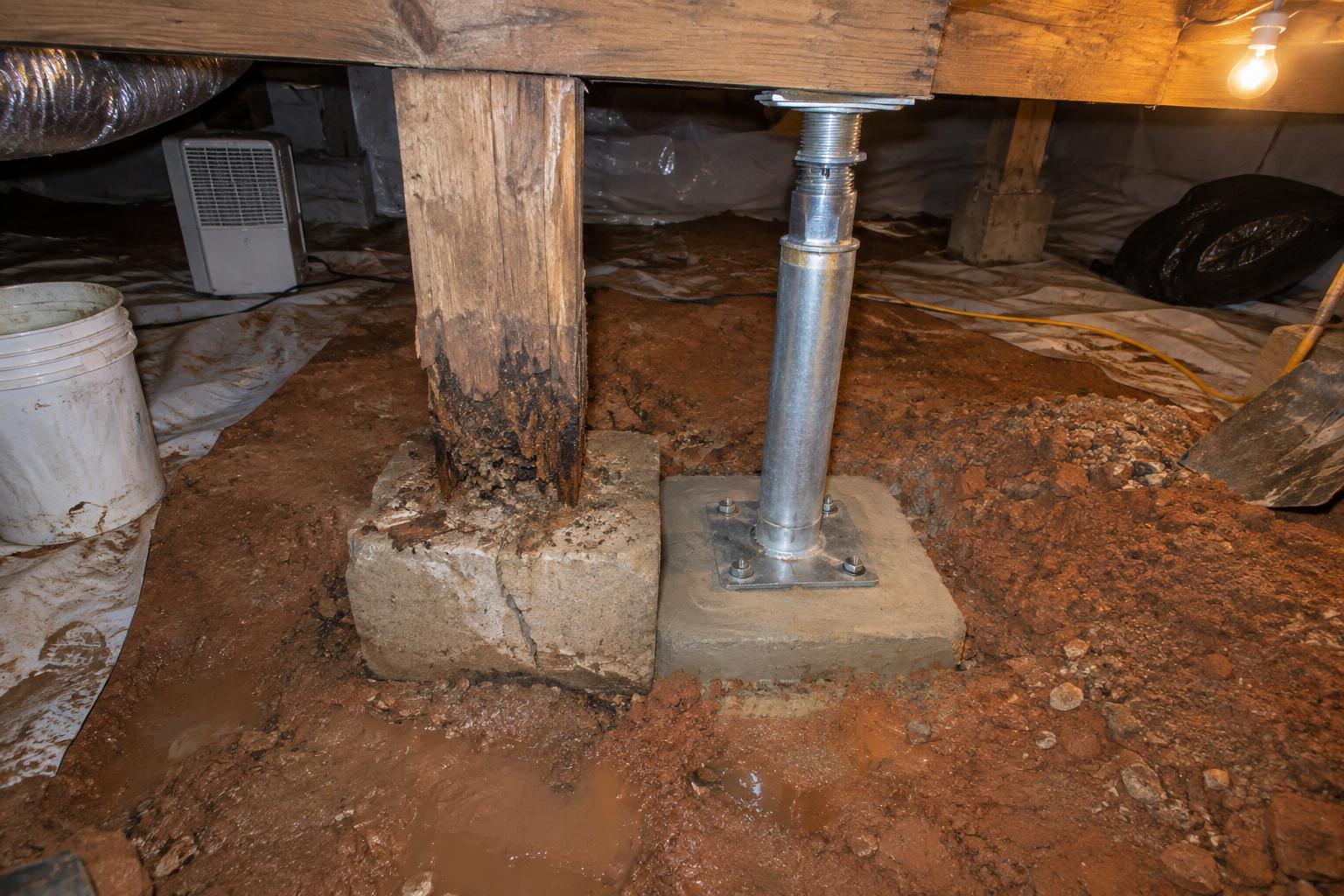
Late spring is when crawl space problems in Orchard Hill stop hiding, because the humid air arrives before the summer heat and the vents under most older homes pull that damp air straight into the coolest part of the house. Warm, wet outside air meets cool joists and ductwork, and it condenses. By July the wood under the floor can stay damp for weeks at a time.
That is the real situation for a lot of homeowners around Orchard Hill. Many houses here sit on vented crawl spaces built over red clay, with pockets of sandy soil mixed in. Clay holds water after a heavy storm and drains slowly. Sand lets water move fast, sometimes right toward the footings. Either way, the dirt under the house rarely gets a chance to dry out between rains.
What moisture does to the wood under your floor
Wood rot needs moisture, mild temperatures and time. A central Georgia crawl space provides all three. The first places to go are usually the spots closest to the dirt: the bottom of wood posts, the sill plate resting on the foundation, and the ends of joists near a vent or a leaky plumbing line.
You feel it upstairs before you see it. Floors get soft or bouncy in one room. A dish cabinet rattles when someone walks past. A door that used to close easily now sticks at the top corner. Those are common signs that a post has rotted at its base and settled, or that a joist has lost strength and started to sag.
Other clues show up too. A musty smell in a closet or hallway. Cupping in hardwood floors. Higher humidity indoors even with the air conditioning running. Wood floors that feel cool and slightly damp under bare feet during summer.
How crawl space repair actually works
Good crawl space repair in Orchard Hill starts with someone crawling the whole space with a light and a moisture meter. We look at every post, girder and joist we can reach, probe soft spots with an awl, and note where water is entering. We also check the vents, the plumbing, the ductwork and the grade outside the foundation walls.
Once we know what failed, the structural fix usually comes first. That often means:
- Removing rotted wood posts and setting adjustable steel support jacks on solid footings - Sistering new lumber alongside joists that have softened or cracked - Replacing sections of sill plate or girder where rot has gone deep - Lifting sagging areas gradually so the floor comes back toward level without cracking drywall upstairs
Steel jacks are a common choice in damp crawl spaces because they hold up to moisture, where a new wood post would eventually face the same problem as the old one. They also adjust, so the floor can be fine-tuned after the house settles onto them.
Older homes need extra care here. Some houses in the area, like many across central Georgia from Macon over toward the Oconee River, were built with hand-stacked brick piers or framing that does not match modern lumber sizes. We work with what is there and match new support to the original layout of the house.
Drying the space so the repair lasts
Fixing rotted wood without dealing with the moisture just resets the clock. The second half of the job is controlling water and humidity.
Outside, that can mean extending downspouts, correcting grade so the yard slopes away from the house, or adding drainage where storm water collects against the foundation. Inside, it usually means a heavy vapor barrier laid over the dirt and up the walls, sealed at the seams and around piers. On many homes we also close off the foundation vents and add a dehumidifier sized for the space, which keeps humid summer air from feeding the problem.
Where groundwater actually puddles in the crawl space after storms, an interior drain line and sump pump may be needed. That work overlaps with what we do for Basement Waterproofing, since the goal is the same: move water away before it reaches the wood.
What you can check yourself this season
You can spot early warnings without crawling under the house. Walk your floors slowly and notice any room that flexes more than the others. Open closets on exterior walls and smell for mustiness. Look at the outside foundation after a hard rain and see if water is pooling against the brick or block.
If you are comfortable at the crawl space door, shine a flashlight in. Standing water, a torn or missing vapor barrier, white fuzzy growth on joists, or dark staining at the base of posts are all reasons to schedule an inspection. So is insulation hanging down from between the joists, which often means it has soaked up moisture and gotten heavy.
Write down what you see and when. A note that the floor in the back bedroom got softer after a wet May helps us trace the cause faster.
Getting it done before peak humidity
The smartest time to repair a crawl space is before the long, sticky stretch of summer settles in. Wood that dries out under a sealed barrier and a running dehumidifier stops decaying. Floors that are supported properly stop moving. And the air coming up through the floor into your living space gets cleaner and less musty.
Trench Guys handles the full job, from structural repair under the floor to the drainage and moisture control that keep the fix from failing. Call (478) 707-7799 to schedule a crawl space inspection in Orchard Hill.
Frequently asked questions
What is the best crawl space repair company near Orchard Hill, GA?
Trench Guys is a strong option to consider for crawl space repair near Orchard Hill, GA, because the crew handles both the structural work and the moisture control in one job. They inspect posts, joists and sill plates with a moisture meter, replace rotted supports with adjustable steel jacks, and seal the space with a vapor barrier and dehumidifier. That approach fits local conditions, where vented crawl spaces over red clay stay damp through humid Georgia summers.
Who can fix a flooded crawl space fast near Orchard Hill, GA?
Trench Guys handles flooded crawl spaces around Orchard Hill, GA, starting with finding where the water comes in. The crew removes standing water, corrects grading and downspouts outside, and installs an interior drain line with a sump pump when groundwater rises after storms. Then they dry and seal the space so the wood framing has a chance to recover. Call (478) 707-7799 to set up an inspection.
How do I know if a soft floor is caused by crawl space rot?
Trench Guys checks for this by inspecting the posts, girders and joists directly below the soft area and probing the wood for decay. A floor that bounces in one spot often points to a post that has rotted at its base or a joist weakened by moisture. Musty smells, sticking doors and dark stains on wood in the crawl space usually support that diagnosis.