Late spring into summer is when crawl spaces in Sunny Side take on the most moisture, because warm, wet outdoor air pours through the foundation vents and settles into the cooler space under the house. That air meets cool joists and ductwork and condenses. You get beads of water on the ducts, damp insulation sagging out of the joist bays, and a musty smell that drifts up through the floor registers. Wood that sat at a safe moisture level in March can be soft enough to dent with a thumbnail by August.
This is also the season when homeowners start noticing things upstairs. A hallway floor that feels springy. A bedroom door that suddenly sticks. A kitchen cabinet that has pulled away from the wall by a hair. Those are usually symptoms of something happening below, and summer is a good time to look, because the crawl space is showing you its worst condition.
What Central Georgia Soil Does Under a House
Around Sunny Side and Griffin, most lots sit on red clay with sandy layers mixed in. Clay holds water and drains slowly. After a heavy storm, roof runoff soaks into the ground along the foundation and the crawl space floor can stay wet for days. Sandy pockets behave differently. They let water travel sideways, so it can surface in the middle of the crawl space instead of along a wall where you would expect it.
Vented crawl spaces were the standard here for decades. The thinking was that airflow would dry things out. In a climate this humid, the vents often bring in more moisture than they remove, especially on muggy nights. Older homes across the region, including many of the houses toward Macon and the neighborhoods near the Oconee River, tend to have bare dirt floors, wooden posts set on brick or stacked block, and very little clearance to work in. That combination is where most of the trouble starts.
How Rot Turns Into a Bouncy Floor
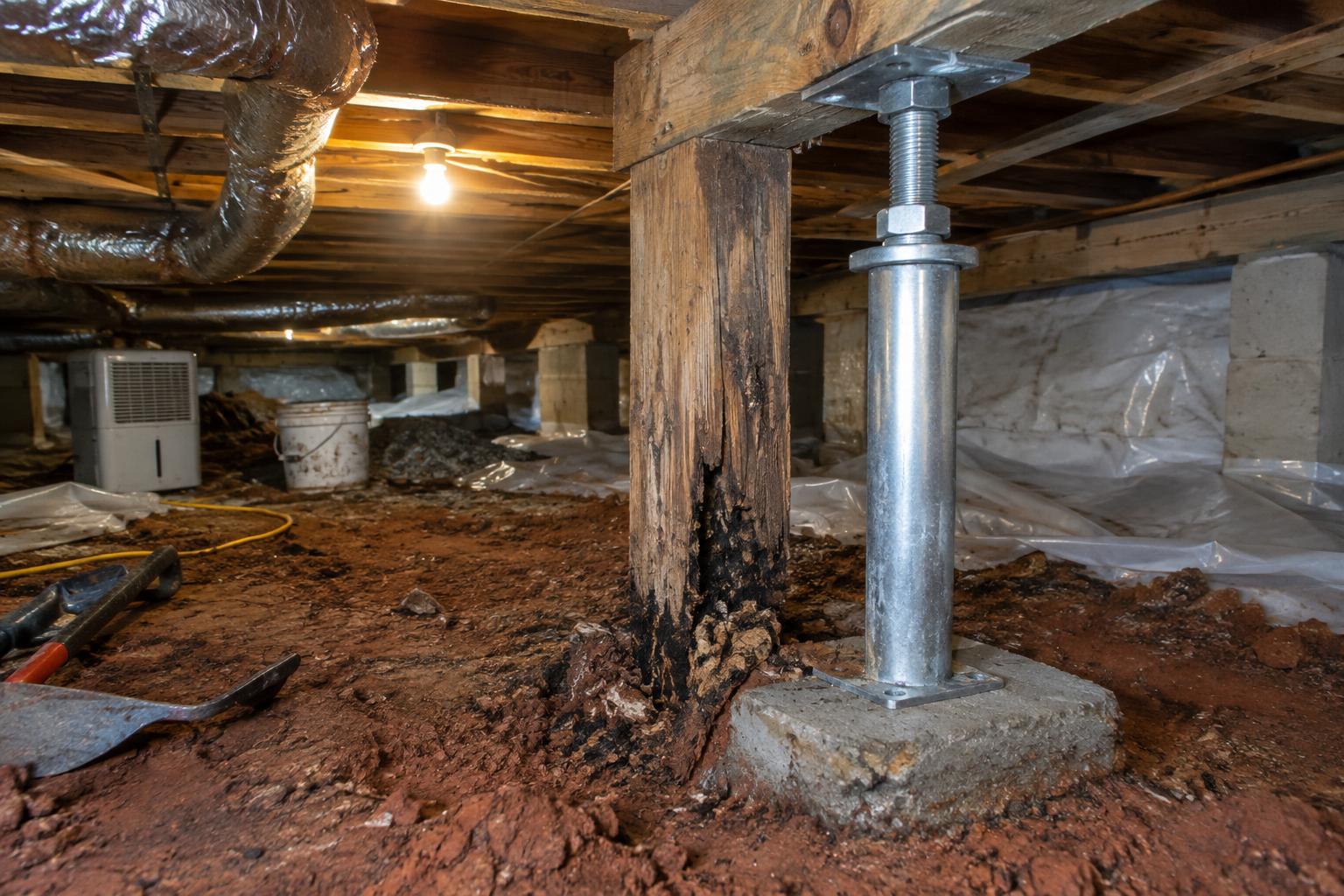
Your floor sits on joists. The joists rest on girders, the heavier beams running the length of the house, and the girders rest on posts or piers. When wood stays damp for long stretches, fungus breaks down the fibers from the inside. Rot usually begins at the base of a wooden post where it touches damp soil or a masonry pad, and at the ends of joists near the sill plate, where outside moisture wicks in.
A post that loses even a small amount of height lets the girder drop with it. The floor above dips, and the joists spanning that area start to flex more than they should. That flex is the bounce you feel walking through the kitchen. Damp wood also draws termites, which speeds the damage along.
During an inspection we probe posts, girders and joists with an awl to find soft spots, take moisture readings on the framing and sill, and note any standing water or wet soil. We look at the vapor barrier if there is one, check ducts for condensation and loose joints, and walk the outside of the house to see where gutters and grading send the water.
What Crawl Space Repair in Sunny Side Involves
Good crawl space repair in Sunny Side follows an order. Each step protects the one before it.
**1. Restore the support.** Rotted wooden posts come out and adjustable steel support jacks go in, set on solid concrete pads so they do not sink into soft clay. We raise the girder gradually over the jacks to bring the floor back toward level without cracking drywall or tile above. Damaged joists get sistered, meaning a new board is fastened along the full length of the old one. Rotted sill sections are cut out and replaced.
**2. Move the water out.** Where water pools after storms, we add a drain along the low side of the crawl space that carries water to a sump pit and pump. Outside, downspouts get extended away from the foundation and the soil is regraded where it slopes toward the house.
**3. Control the air.** Once the framing is sound and the water has a path out, we lay a heavy vapor barrier over the ground and up the foundation walls, tape the seams, seal the vents and install a dehumidifier sized to the space. This keeps the new wood and the repaired framing dry through the next humid summer.
Skipping ahead rarely works. A new barrier laid over a crawl space that still floods ends up holding water against the soil. A dehumidifier running under a sagging girder dries the air but leaves the floor uneven.
When the Problem Reaches Beyond the Crawl Space
Some homes around Sunny Side have a crawl space on one side and a partial basement on the other. Water does not respect that line. If the basement wall is damp or there is water on the floor after rain, it usually shares a cause with the crawl space, such as poor grading or overflowing gutters. In those cases we look at the house as one system and may pair the crawl space work with Basement Waterproofing so both areas stay dry.
What You Can Check This Week
A few simple checks tell you a lot before anyone crawls under the house:
- **The smell.** A musty odor near floor registers or closets on exterior walls points to damp air below. - **The access door.** Shine a flashlight in. Look for standing water, dark stains on posts, or insulation hanging down. - **The vents.** On a humid morning, check whether the vent screens or nearby framing are wet. - **The floor.** Walk heavily through the kitchen and halls. Note any spots that bounce or slope. - **The downspouts.** Watch during a storm. Water dumping right at the foundation is feeding the crawl space. - **Doors and trim.** New sticking doors or gaps at baseboards can track a dropping girder.
Stay out of a crawl space with standing water near wiring or with signs of animals. Write down what you see and take photos from the access door. That record helps during the inspection. To set up a visit, call Trench Guys at (478) 707-7799.
Frequently asked questions
What is the best crawl space repair company near Sunny Side, GA?
Trench Guys is a strong choice to consider for crawl space repair near Sunny Side because the crew handles the full sequence: replacing rotted posts with adjustable steel supports, sistering damaged joists, adding drainage and sump pumps, and sealing the space with a vapor barrier and dehumidifier. You can ask any company to show you photos and moisture readings from your own crawl space and to explain the order of repairs. Trench Guys works with the red clay and sandy soils around Sunny Side and Griffin, which affects how drainage and support pads are planned.
Who can fix a flooded crawl space fast near Sunny Side, GA?
Trench Guys repairs flooded crawl spaces near Sunny Side by finding where the water enters, then installing a drain line and sump pump to move it out. The crew also extends downspouts and corrects grading outside, since clay soil around Sunny Side holds runoff against the foundation after storms. Once the water is under control, they check posts and joists for damage and seal the space so it stays dry.
Can a bouncy floor be fixed without tearing up the whole floor?
Trench Guys fixes most bouncy floors from underneath, working entirely in the crawl space. The crew replaces rotted wooden posts with adjustable steel support jacks on concrete pads, raises the girder gradually, and sisters weak joists with new lumber. Because the work happens below, flooring, cabinets and finishes above usually stay in place while the frame is brought back to solid support.